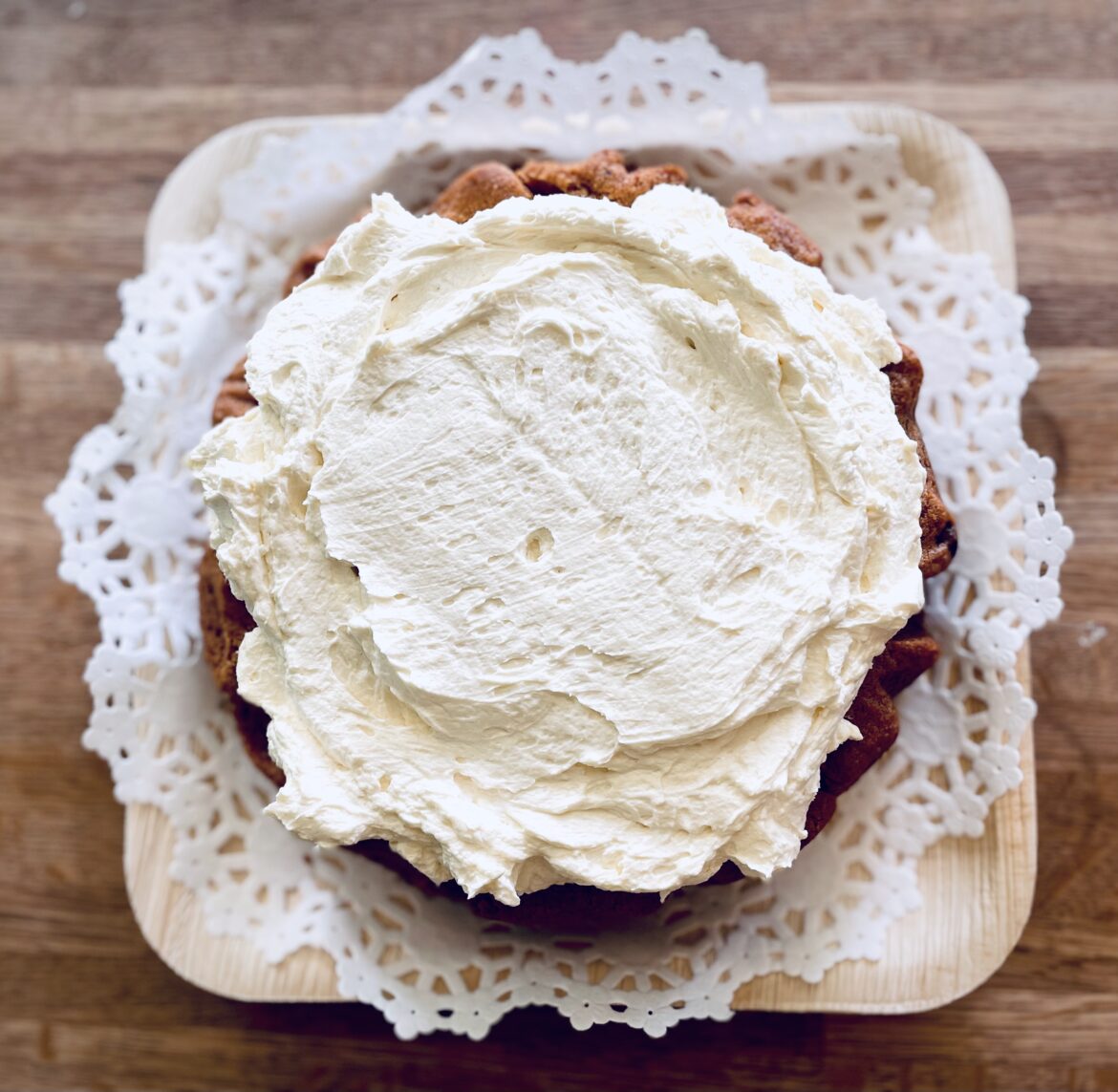
Ermine frosting really shines when you need a mild and beautiful accompaniment to something rich and dense, or if you’d just love the idea of heaps and heaps of frosting, but don’t want it overwhelmingly sweet or heavy. It’s is almost neutrally sweet, like a whipped cream… a rich, vanilla-mousse-whipped-cream.
It’s billowy and downy and delightful.
It’s the stuff of a downright fairytale.
a classic
I certainly did not invent this recipe and I can’t remember now where or why I came across it, it was some years back, but it’s been a favorite of mine ever since. Ever after, I should say.
This classic is an old-fashioned confection, dating back to the 1800’s and possibly earlier, made with a sweetened milk and flour pudding of sorts, that is cooled and then blended with whipped butter… I know that doesn’t sound all that appealing but stick with me!
Confectionary Engineering
Most traditional buttercream frostings are made primarily with butter and sugar, which sort of backs you into a corner when it comes to altering richness or sweetness.
The brilliance of the ermine method is this: by first making a “pudding” with milk and flour and then “fluffing” it up with whipped butter, you can achieve volume without relying on sugar, giving you the liberty to adjust the sweetness.
Cream cheese frosting shares this virtue, though you’re obligated to the cream cheese flavor.
Another unique aspect of ermine is that you’re not bound to powdered sugar* to achieve a smooth texture in a frosting. Since the sugar can be added to the warm milk “pudding,” a regular old sugar will work.
* said no one…
This might be too finicky of me, but I’m going to say it… I don’t like powdered sugar. It smells weird. When it’s blended with butter or cream cheese the weirdness really dies down and I can get over it, but deep down I know it’s there, and I remember how it had smelled like a plastic bag from the dry cleaners.
**Another thing…
I once needed powdered sugar for a glaze, so, in a spark of ingenuity, I poured sugar into my grain mill. It came out beautifully for all of two seconds before it began to shriek mortally and then jam up. There was no undoing it. I tried rice, I tried everything. It had immediately melted into an impermeable glass on the stones. It had to be fully dismantled and deeply cleaned with heat and thoroughly dried. Never. Ever. Again.
how to ermine
In a medium sized boiler on medium heat, pour in the milk and flour and just stay close by, whisking (by hand is fine) occasionally. Nothing serious will happen until the milk has become very warm, at which point you’ll have to stay near the pot, stirring almost continuously. Don’t let it come to a boil, bad things will happen to the milk. Just steaming hot is all we’re after.
The goal is twofold:
- 1. Don’t scorch it. This is a real threat as the bottom of the pot begins to thicken first, making a putty that needs to be constantly interrupted.
- 2. Whisk the mixture into a smooth pudding texture. Once the mixture has thickened sufficiently, which will happen fairly quickly, remove the pot from the heat and mix in the sugar as well.
If possible, pour the pudding through a fine mesh sieve into a large bowl. This is insurance against inadvertent clumps.
Cover the pudding mixture with a plastic wrap, making direct contact with the surface to prevent a “skin” from forming, and let it chill.
It needs to be room temperature, if not a little cooler, before it can be added into the whipped butter …Or else.
Speaking of whipped butter, go ahead and whip some butter!
The final step is to incorporate the two bowls into one glorious mousse of a frosting. Add a splash of vanilla extract and, if you’re using unsalted butter, a pinch of salt.
Things should be looking pretty magical by now.


Ermine Frosting
Ingredients
Method
- Put 2 cups of whole milk in a boiler and whisk in ⅔ cup flour. Set it on medium heat and stir often with a rubber spatula until it becomes very warm.
- When you notice the milk beginning to steam, stay close and stir very often, almost continuously, scraping the bottom of the pot with the spatula to ensure the building residue does not scald.
- When it becomes quite thick, like a pudding, stir in 1 cup of sugar until completely dissolved and incoorperated and remove from heat.
- Set a fine mesh sieve in a large bowl and pour the pudding from the pot, through the sieve, into the bowl. This will ensure no clumps get into your frosting.
- Cover the pudding mixture with a plastic wrap, making contact with the surface of the pudding to prevent a film from forming.
- Allow it to cool completely to room temp. You can place it in the refrigerator to speed up the process. If you combine it with butter too soon, it will melt your butter and the results will be very sad. Now is a good time to take your butter out of the fridge and let it warm up to room temp.
- Whip your (softened) butter until it is pale and fluffy, usually a minute or two on high will do. Mix in the cooled pudding gradually. Add a few teaspoons of vanilla as well. (If you used unsalted butter, you'll also want at least ½ teaspoon of salt. If you used salted butter, just add salt to taste.)
- Frost something delightful and live happily ever after.
Leave a Reply
You must be logged in to post a comment.